Posts

Showing posts with the label Netbeans

fedora, the day after

Image
Playing a bit with Fedora 19 after morning chores and before I head out for some late morning errands. The performance of the desktop is reasonable but not blazing fast, which is to be expected on a VM. It's Good Enough for what I want to accomplish, which is functionality. If I need performance and if the application isn't Linux-specific then I'll move it over to Windows 8, shut everything down that isn't necessary, and run it on an OS running on bare silicon. I decided to install Netbeans 7.3.1 on this VM to see how it performs. So far it's usable. In addition to Java support I also installed support for C++ (see why below). I'm also going to install Scala support as well to mirror how I have Netbeans 7.3.1 installed on Windows 8. After further investigation I've discovered that the version of Java being pushed by Fedora 19 is Java 7 update 25, which is the current Oracle release. I may (I say may) uninstall the Oracle version and go with the version...

At Work With Linux: Digging Into Ubuntu 11.10

Image
Running synaptic from Dash. Note that I've also dropped the synaptic icon on the left vertical launcher. I received a couple of questions from Rick Reumann via a comment on the post " At Work With Linux - Ubuntu 11.10, Day 2 ". His questions are at the bottom of the page and boiled down to how to setup synaptic as the default installer such that double clicking on a .deb file starts it up, and how to start synaptic from Dash and hopefully from the launcher. Starting with the second question I was able to start synaptic from Dash, and I was able to drag and drop the icon to the launcher such that clicking on the synaptic icon launched it. So that part did work for me. Unfortunately, I have no answers for the rest of his questions. You can't create individual application launchers on the desktop, and you can't create them on the fly on the launcher bar. I did discover while installing the NetBeans IDE 7.1 RC2 downloaded from Oracle that you could programmati...

Netbeans 6.7 Milestone 3 released

Image
It's been a while since I commented on either the Eclipse or Netbeans IDE. Depending on the project, I've been using both. As I've noted in the past both are of very good quality, so it's a matter of personal taste as well very specific requirements which one you select for a given job. The Netbeans project is currently working on its next release, version 6.7. Milestone 3 was just released, and you should take a quick look at it's " New and Noteworthy " section (along with New and Noteworthy from milestones 1 and 2 ). Of particular interest is the dependency graph in Maven support. I'm reminded of Doxygen and the graphical support in Together (now owned by Borland). Doxygen and Together are for software engineering as apposed to project management and control with Maven, but the core needs are the same. I could see myself working on extending UML support and round-trip engineering with dependency viewing just like in Doxygen (assuming it hasn't be...

Updates

I've gone through a series of notable hardware and software updates so far this year, and it's barely February. In no particular order: Dell D630 Memory Update I upgraded the D630 from 2GB to 4GB (2 x 2GB sticks) for a mere $70 total from Dell itself. This was for the company notebook. By the time Windows is up and running I can only 'see' 3.5GB, but it's worth it, and if I need all that memory I can swap around my hard drives and run Fedora 10. I run Widows XP SP3 primarily. Windows applications include Google Chrome, Google Earth, Visual Studio 2008, NetBeans IDE (6.5 and 7.0M1), Eclipse (3.4.1 and 3.5M5), as well as Office 2007 and Visio 2007 professional. And then there are other project-specific applications (EventStudio System Designer, for example) and testing applications before deploying. It's not unusual for me to hit 1.5GB with everything up in a normal day-to-day workflow, and I was not happy to hit swap on this notebook. So I bumped up memory and ev...

My first taste of Mono on openSUSE 11.1

Verdict: not so tasty I grabbed all the Mono packages via YaST and installed them without problems. I then fired up monodevelop in a terminal so I could watch for warnings and errors. I'm glad I did. I won't bore you with screen shots of creating a simple 'Hello world' application. I will say that monodevelop is crashy. For example, without having created anything, I attempted to see what the Classes tab on the left side of the IDE would produce if opened. Normally it should be blank; that's what every other IDE in the known universe shows. Instead MonoDevelop crashed and exited. Hmmm... After the second startup I created the simple 'Hello World' project as a console program with Gtk# extensions. I didn't add any other code. I then had the project build and run within the IDE. During that entire time I got a stream of error messages, such as the following sample: ERROR [2008-12-22 10:49:57Z]: Mono.CompilerServices.SymbolWriter.MonoSymbolFileException: Ca...

Minor JRuby issue with Rails and NetBeans 6.5

Image
Whilst playing around with NetBeans 6.5 and JRuby on my shiny new openSUSE 11.1 installation, I decided to create a new Rails project. It's been quite a while since I last played with Ruby on Rails, so I decided to start from scratch. One of the choices I made in the new project's creation was the selection of JavaDB (a.k.a. Derby) as the database. I also choose to use JRuby 1.1.6, which was released 17 December, instead of the built-in NetBeans version, 1.1.4. JRuby 1.1.6 is installed external to the NetBean's installation location. While attempting to run (for the first time) the project, it stopped with an error in the output window (see below). The error was that it could not establish a connection with Derby and that I needed to install the Derby adapter gem; 'gem install activerecord-derby-adapter'. The problem is there is no gem with that name. Instead you need to type 'gem install activerecord-jdbcderby-adapter'. There is a reporting bug within conne...

openSUSE 11.1 installed and running

Image
I hadn't received my openSUSE 11.1 boxed set yet, in spite of pre-ordering it December 9th, and it looks like it won't ship until January 5th. No matter. The downloadable ISOs are available and I just grabbed the official release versions and re-installed. Installation from the LiveCD was super simple. In fact it may have been too simple. I missed the part where I could specify the system name, and I never caught it. Instead the system name wound up being 'linux-0dg5' which I have no idea how it was derived. In the end I grepped for the system name in files located under /etc, and changed (with vi) it to 'europa' in just about every file where it seemed to matter (/etc/postfix/main.cf, /etc/hosts.YaST2save, /etc/HOSTNAME, and /etc/hosts). There are a set of files under /etc/ssh that still have the older system name, but I'll deal with them at a later time. The screen shot above is the recently released NetBeans 6.5 running with the latest Java, version 1.6.0...

Notes from the field: Fedora 10 and OpenSUSE 11.1 RC1

Over the weekend I had the opportunity to install Fedora 10 on a Dell Latitude D630 notebook and to tweak the OpenSUSE 11.1 installation on europa. Fedora 10 Fedora 10 was installed on a spare 120GB hard drive. It was installed over Fedora 9, which I had managed to configure into a reasonable working state and had used for about five months. But it wasn't perfect. While I was able to install the Nvidia driver and enable 3D hardware acceleration, sound and wireless did not work. With Fedora 10 I now have sound, but the wireless still doesn't work. Even though I installed both Fedora 9 and 10 from DVD, I only installed the Gnome desktop under Fedora 9. With Fedora 10 I installed the Gnome, KDE, and Xfce desktops. After the installation I was only able to select between Gnome and KDE, although I could see the Xfce tools (such as Thunar ) on the Gnome menus. Both Gnome and KDE worked fine until I installed the Nvidia drivers for Fedora 10 ( kmod-nvidia ). After installation the Gno...

Postcard from the edge

Image
This past Thanksgiving has been ... unique. I've spent a lot less time doing what I planned because of its uniqueness. Regardless, I managed to tinker a bit with some of the latest offerings. NetBeans 6 RC2 RC2 was released right before Thanksgiving. I've got it installed on Windows XP 2 (algol) and Ubuntu 7.10 (europa, shown below). On algol, with its 2GHz Core Duo processor, RC2 runs smooth as silk. It should considering the processing horsepower. On europa, with its single-core 2GHz Athlon XP, it runs a little rougher, especially at startup. To make the NetBeaners feel a little better, Eclipse 3.3.1.1 has the same problem on europa (see below). It takes about 20 seconds after the main window has appeared for responsiveness to be useful. And this only occurs the first time you start it up. Of course, for many people such as myself, you start it and leave it running for long periods lasting days at a time. Regardless of the initial startup lethargy, RC2 shows considerable poli...

CORRECTION: NetBeans 6RC1 has serious performance issues on Ubuntu 7.10

In the earlier post I reported that NetBeans 6RC1 had serious performance problems. After installing the latest ATI graphics driver and disabling XGL, NetBeans' performance was enhanced to levels seen in the past with older releases and is now quite acceptable. My only comment (and concern) is how XGL could have had such an adverse impact on NetBeans' performance. Again, as I mentioned in the earlier post, Eclipse 3.3.1.1 did not have this performance problem. I hope it isn't due to the fact that NetBeans depends on JFC while Eclipse uses its own widget toolkit, SWT. I did run some of the simpler JFC examples from the JDK (SwingSet2 and Java2D) and found no performance issues running them. I wonder what special features NetBeans is now using from Java that might cause this?

NetBeans 6RC1 has serious performance issues on Ubuntu 7.10

Image
I've been running Ubuntu 7.10 on europa, with basic 3D hardware acceleration via the native ATI drivers and some of the eye candy turned on. I have been pleased with just about everything except where noted. I decided to install the latest NetBeans 6 release, RC1. I downloaded it and installed it, and then fired 'er up. The first thing I noticed was the performance. It is, in a word, abysmal. It starts up slow and it runs slow. And I do mean slow. Up to this point developer releases of NetBeans 6 have not had such drastic performance slowdowns. And this performance slowdown is only observable on Ubuntu 7.10. NetBeans 6RC1 runs just fine on Windows XP SP2. The problem presented an interesting opportunity to compare NetBeans 6 RC1 with the version available on Ubuntu via Synaptic, NetBeans 5.5.1. Using Synaptic I found and installed that (current) version of NetBeans and started it up. The screen shot shows both running on the desktop. Version 6 RC1 is on top and version 5.5.1 i...

Ubuntu 7.04 upgrades to Ubuntu 7.10

In between chores around the house (wash, mowing, cleaning, shopping, and walking Max) I upgraded rhea from Ubuntu 7.04 to 7.10. I used the method documented on the Gutsy Gibbon page. It was almost totally automatic. I had to come back to the computer between tasks to answer a few dialogs asking questions along the way. The questions themselves were simple and straightforward. When the upgrade was finished the system was running Ubuntu 7.10 Beta 1. First, the good news. It was unbelievable that the system upgraded and ran at all, let alone exactly as I had configured it before the upgrade. After reading one horror story after another in various fora about how Ubuntu upgrades had failed, I wasn't sure how it would all finish. But finish it did. Java is up to Java 6 Update 3. I had to check both synaptic as well as 'java -version' just to be sure. This is one upgrade higher than what is available from Sun's site itself. Furthermore, NetBeans 6 Beta 1 ran with the earlier...

openSUSE 10.3 RC1: Issues with Compiz and XGL

Image
I've been trying to get Compiz effects enabled, and so I installed all the Compiz bits available via YaST. To make a long story short the effects, while enabled, were less than desirable. The longer I attempt to work with Compiz (and now Compiz Fusion) the more I've come to hold it in the same low esteem as I hold Vista's Aero interface. There's also one other direct effect I have no use for. XGL interferes with my other OpenGL work on this platform. After unistalling the compiz packages via YaST (because the tool to turn it off was broken), I attempted to get back to work with my WorldWInd/NetBeans project. I ran it for a test, and discovered that the WorldWindGLCanvas would not render the map. It would render the test and the compass rose, but not the underlying map. So I brought YaST up one more time, searched for opengl-based packages, and discovered that xgl was still installed. Once I uninstalled xgl and restarted the system to make sure everything was flushed, I ...

openSUSE 10.3 RC1: ATI drivers installed

Image
I finally installed the latest ATI drivers on openSUSE 10.3. I generally followed the core directions normally given for installing under openSUSE 10.2, and had no problems. I'm going to document the fast way I did this. Download the ATI binary drivers and put them in a working directory. It doesn't matter where. Open a shell Change to the working directory where you stored the downloaded drivers. Run the download as follows: bash ati-driver-installer-8.40.4-x86.x86_64.run --buildpkg SuSE/SUSE102-IA32 There is no SUSE103-IA32. Don't be concerned with using 10.2. And note that this is all one line. Change directory to /usr/src/packages/RPMS/i386 Type 'rpm -hiv fglrx_7_1_0_SUSE102-8.40.4-1.i386.rpm' Type 'aticonfig --initial' Reboot Once rebooted and logged back in you might want to run the following command inside a shell. wbeebe@europa:~$ fglrxinfo display: :0.0 screen: 0 OpenGL vendor string: ATI Technologies Inc. OpenGL renderer string: RADEON 9700 PRO ...

NetBeans 6 Beta 1 running on a constrained system

Image
In an earlier post dinesh left a comment complaining about the poor performance of NetBeans 6 on his system as compared to earlier versions. This led me to upgrade my version rhea, the Ubuntu 7.04 test system, to NetBeans 6 Beta 1 from Milestone 9. I also upgraded to Java 6 Upgrade 2. I then started NetBeans 6 and ran some simple tests to see how well it performed on the desktop. rhea has "only" 512MB of DRAM like dinesh's system. The processor is a single-core 32-bit Athlon XP 2500+ running at 1.8 GHz. dinesh's was a dual-core Pentium 4. Running NetBeans with Firefox is a mistake, especially if Firefox has been up for some time and has multiple tabs open. The keyboard response was horrible. This may be part of dinesh's issues with regards to performance. Of course running anything substantial with Firefox on this machine has been horrible, which is a shame. Once Firefox exited the response in NetBeans 6 was quite good. Even after restarting Firefox the response ...

openSUSE 10.3 RC1: More things are beginning to work

Image
As noted in earlier posts about using Java 6 Update 2 on openSUSE 10.3 with graphical applications, such as NetBeans , I've since discovered a second solution to the Java 6 problem. Use Java 6 Update 1 as provided via the restricted formats page . I've already documented how I did it (in two steps, naturally, instead of one). I should have checked to see if Java 6 U1 as provided by the community would have the same problem as Java 6 U2 downloaded from the Sun site, but I didn't. I automatically assumed that if Java 6 U2 had a problem, then so would the slightly older U1. If there is no pressing bug fixed in U2 that you have to have, then my advice would be to install U1 and to work with it. That keeps you from having to add the environment hack in order to get applications such as NetBeans 6 Beta 1 working. Update I have Eclipse 3.3 installed on this system as well as NetBeans, and Eclipse 3.3 runs as well with Java 6 Update 1 or Update 2. I believe this is possible beca...

openSUSE 10.3 RC1: problem with X11 and Java 6

Image
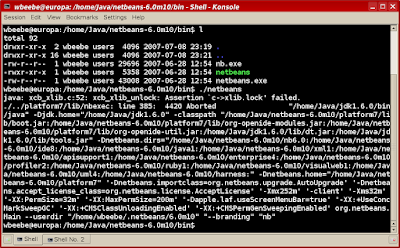
I ran across a rather bazaar problem with Java 6 Update 2 and NetBeans 6. First, a copy of the terminal with the exception that was thrown when I tried to run NetBeans 6. I then went googling for the error message: java: xcb_xlib.c:52: xcb_xlib_unlock: Assertion `c->xlib.lock' failed. I found the same problem and a solution on another forum, and the solution is to add the following to your environment: export LIBXCB_ALLOW_SLOPPY_LOCK=1 Sure enough I added it to the local window's environment and it started right up. I need to add it to my login environment. In all the time I've run any distribution I've never run across the problem. They currently run just fine on openSUSE 10.2 and Ubuntu 7.04. Must be clean living and lots of dumb luck. Here's another one to check and see if it still exists when openSUSE 10.3 final is released.

NetBeans 6 Beta 1 nano review

Image
NetBeans 6 Beta 1 was finally released today. I've been anticipating this for some time. I was able to grab a copy and give it a spin, first on Windows SP SP2 and then on Linux. The test machine was my Gateway M685 Core Duo notebook. What follows are a quick set of 'unboxing' screen shots as I install NetBeans 6, load an existing project, add a new repository, and then create a new project based on the new repository. NetBeans 6 has a nice, professional looking installer that allows you to easily pick the various features you want from a single installation package. If you've been working with NetBeans 6 since about Milestone 9, then you'll know what I'm talking about. For this very simplistic evaluation I installed the Base IDE, Java SE, Web & Java EE, UML, Ruby and C/C++. What I didn't install were the Mobility tools, SOA, GlassFish V2, and Open ESB V2 Preview 3. I may add them later as the installer allows you to add them after the initial installatio...

NetBeans 6 nightly build on openSuse 10.2 running JOGL demo

Image
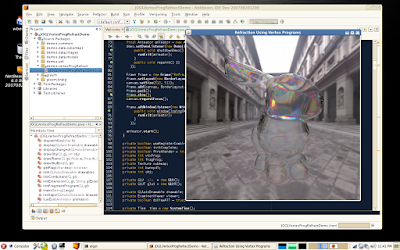
Here's a neat trick. I installed tonight's NetBeans 6 nightly build (20708201200) and then installed the NetBeans OpenGL Pack . From there I proceeded to create and simply run one of the JOGL demos, JOGL Vertex Program Refraction Demo. The demo is a slowly rotating glass bunny in the middle of a very (very) basic 3D scene. Remember in the last post where I threw out some very lame graphics performance numbers using glxgears? In this example I have NetBeans 6 nightly builds installed on both algol (nVidia) and triton (ATI). I can't offer numbers as with glxgears, but in both cases the demos build and run flawlessly, and their performance is indistinguishable both in rendering as well as overall performance. I have Java 6 Update 2 installed on algol and NetBeans is running with it. Algol is a potent little Linux platform. Java 6 and NetBeans 6 are a combination ripe with possibilities on this platform.

NetBeans Notes from the Field

Image
I got my very own copy of Rich Client Programming at a local Barnes and Noble bookstore today. I purchased it for two reasons; to learn more about the NetBean's internals, especially with regard to reusing it as a foundation (or platform) for my own applications, and to help fund the effort and hopefully make it successful enough for more books like this in the future. Many will look at dead tree documentation as a complete waste. But the effort to gather and organize information for publication produces the most focused collection of accurate information you're going to read anywhere. Over the years I've discovered that a bad book is far better than a 'good' collection of on-line documentation, especially if it's a computer book. There are thousands of years of refinements in how to publish books. The books we take for granted trace directly back to the fifteenth century and Gutenberg's invention of movable type. I can sit and read a book far more easily t...