Posts

Showing posts with the label Windows

a tale of two distributions: linux mint 16 vs. fedora 20

Image
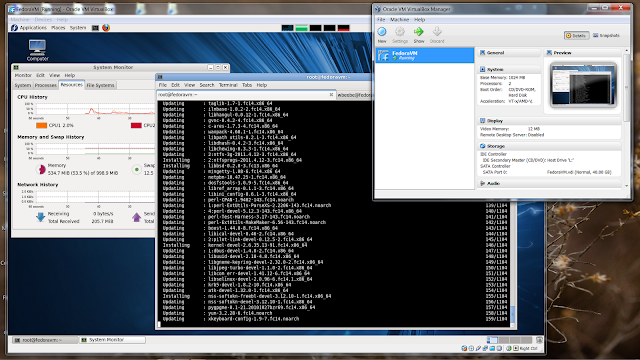
Linux Mint 16 RC VM running Java 7 u45, Apache ServiceMix 4.5.3, and Google Chrome 31 I've installed two more Linux VMs on my little ol' Windows 8.1 notebook using VMware Player 6.0.1. They're Linux Mint 16 RC and Fedora 20 Beta. No need to clog the entry with numerous installation screen captures from both; if you've worked with either Linux Mint 15 or Fedora 19, then there's little if any difference between the two. The primary reasons for moving up to the next release are the software updates. I installed both with the Cinnamon alternative desktop. From a personal perspective I prefer Linux Mint 16's Cinnamon over Fedora's because of Mint's leaner window decorations. When I can change the desktop wallpaper and be done with personalizing for productive use I call that a small personal victory. That happened with Mint, but I still wanted to find a way to narrow the rather large window top, and paradoxically, widen the rest of the window borders ...

vm networking problem fixed

Image
Over the weekend I upgraded to Windows 8.1, then discovered that networking for the virtual machines wouldn't work. Then I tried something incredibly simple and fixed the problem. Checking the system I noticed that three VMware Windows services weren't running; VMnetDHCP, VMUSBArbService, and VMwareNatService. VMware Player allows you to install, remove, or fix an existing installation. I chose to try fixing the installation, and that fixed the problem. The services were re-installed/restarted, and the virtual machines had networking again. Once network connectivity was established there was exactly one updated file for Ubuntu 13.10, a data file. This underscores how solid and finished the release was this time. Every other version of every other Linux installation I've ever dealt with has always been succeeded by boatloads of updates after the initial installation. But not this time. Everything is working properly on my notebook. All's right with the world.

ubuntu 13.10 + windows 8.1 + vmware player 6 = some problems

Image
Update 26 October 2013 All of this has been overcome by events (OBE) as noted in this post:  http://blogbeebe.blogspot.com/2013/10/ubuntu-1310-windows-81-vmware-player.html tl;dr - It's all fixed now. Original It hardly took any time at all for me to download the Ubuntu 13.10 ISO file and install the latest Ubuntu as a virtual machine on VMware Player 6 running on my shiny new Windows 8.1 system. For the most part it's been error and trouble free. Except for one issue, which I'll get to shortly. But first, all the good news. I've read the various "reviews" [sic] from the various online tech pubs, most notably Ars Technica, and the general consensus is "meh." There are times where meh is a Good Thing. The one feature (if you want to call it that) about Ubuntu 13.10 is the polish applied to 13.04. Just as Windows 8.1 can be considered a polished Windows 8, instead of a major new upgrade. In the pell-mell rush to release software to stay ahe...

state of my linux

Image
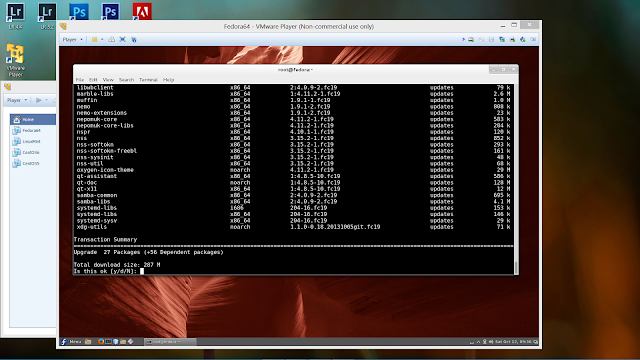
Fedora 19 virtualized on my Windows 8 desktop It's been a while since I commented about Linux. I've been very busy with my career changes as well as learning a new set of skills associated with that career change, including some travel. My use of Linux has settled down as a super-application that runs on top of my Windows 8 system (running on the Samsung Series 7 Chronos). I have four distributions installed these days; Fedora 19, Linux Mint 15, CentOS 5 and CentOS 6. The CentOS installations are there primarily as my final testing sandboxes for RHEL 5 and 6, respectively. Otherwise I do my leading testing and development on Mint and Fedora, usually in that order. Here's a quick rundown of my experiences and observations to date running Linux in this way. Linux Mint 15 . By far and away the cleanest and easiest to work with. Its gcc and clang/llvm installations aren't up-to-date with the latest and greatest as the versions installed on Fedora, so if I really ...

fedora, the day after

Image
Playing a bit with Fedora 19 after morning chores and before I head out for some late morning errands. The performance of the desktop is reasonable but not blazing fast, which is to be expected on a VM. It's Good Enough for what I want to accomplish, which is functionality. If I need performance and if the application isn't Linux-specific then I'll move it over to Windows 8, shut everything down that isn't necessary, and run it on an OS running on bare silicon. I decided to install Netbeans 7.3.1 on this VM to see how it performs. So far it's usable. In addition to Java support I also installed support for C++ (see why below). I'm also going to install Scala support as well to mirror how I have Netbeans 7.3.1 installed on Windows 8. After further investigation I've discovered that the version of Java being pushed by Fedora 19 is Java 7 update 25, which is the current Oracle release. I may (I say may) uninstall the Oracle version and go with the version...

linux at home: running a linux mint 15 virtual machine on windows 8

Image
Windows 8 desktop with task manager and VMware Player booting Linux Mint 15 Back in my last job I got into the habit of installing every Linux distribution when it was newly released. The primary reason was to keep tabs on the evolution of the various distributions. The secondary reason was because VirtualBox, and later VMware Player, forgave a host of sins when trying to install Linux on bare metal, not the least of which was lack of driver support for the latest and greatest peripherals that were evolving at a mad pace on their own. I quickly discovered I had far greater success installing Linux virtually than I ever did directly on a notebook or desktop computer. The icing on the cake was the rapid realization that I didn't have to wipe a drive when I wanted to install a different version of a different distribution. VMs were basically very large disk files, and as long as I had enough disk space (growing from the hundreds of gigs into the single terabytes) I could just crea...

android development on windows 8, step 1

Image
Nexus 7 emulation on left, Eclipse on the right, all hosted on Windows 8 With some time on my hands I'm building a new Android development capability, this time with Android 4.2.2 and my Nexus 7 tablet as the target device. In the past I was targeting Android 2.3 and my Android smartphone, the HTC myTouch 4G. I have several Android projects I'm pursuing that require a tablet as the platform. I intend to target Android 4.2.2 and later; there'll be no backwards compatibility. So far I'm using the emulator that ships with the SDK. I've yet to try to tie my Nexus 7 hardware into this. I will say this, when the directions on the Google site say not to build the device from the command line with the SDK, but build it from the Eclipse IDE, they mean it. I tried to build everything from the command line, and when it came time to try it from the IDE it kept failing because it couldn't find the emulator image. I had to delete both the initial SDK and Eclipse install...

Another Microsoft Failure In The Making

Image
I wanted to wait a while and let the dust settle before wading in with my own not-so-unique comments regarding Microsoft's Surface tablets/slates/whatever-you-want-to-label-them. Current commentary is deeply divided over the obvious business perspective about how Microsoft had to do this because the OEMs had failed vs the perspective of labeling what Microsoft did as " one of the largest and most unethical industrial espionage campaigns of the last few decades ." I'm not here to take one side or the other, but to point out examples from Microsoft's long history why I believe these new machines are doomed to failure. I have long experience of Microsoft products stretching back to MS-DOS and further back to the original Altair Basic for CP/M and the Microsoft Z-80 Softcard for the Apple II, forward through a whole series of mice, keyboards, and X-Box gaming consoles as well as their ill-fate Zune player. But I also remember, from the software side, Blackcomb and...

At Work with Linux: Windows 8 Release Preview

Image
Before I left for home Thursday I started a download of the Windows 8 Release Preview ISO, all 3.3GB of it. I wanted to install it under VMware 4.0.3 on my RHEL 6.2 host just like I'd done with the Gnome 3 and KDE 4 Fedora 17 variants. I learned a bit about Windows 8 and running Windows 8 on a RHEL host. First and foremost, you don't have to install VMware extensions on Windows 8. Everything (mostly) works out of the box, and if you tried to install the extensions they won't. I was able to go in and set the screen size explicitly to 1440 x 900, and the VM window resized accordingly. I'm no fan of the Metro look, and the more they work with it the less I like it. It's fine for a smartphone, but spread out on a desktop screen, not so much. Fortunately it was a simple matter of clicking on the desktop tile to get to the desktop. It still has the right bottom sensitive corner for bringing up the right edge controls. I needed to get to Settings to configure the networ...

Ten Years Ago

Image
Looking at the Android devices that now litter my house (the Motorola Xoom, the Asus Transformer, my wife's and my Android smartphone, our Nook Tablets, and my latest, the re-purposed Nook Color), I'm reminded what I had 10 years ago. I had one new computer. It was a Compaq Presario 5WV280 running Windows ME. It had a 900 MHz AMD 32-bit Athlon with 256MB of memory and a 20GB hard drive. It came complete with color CRT monitor and speakers, and set me back some $2,000. I'd purchased it at downtown Circuit City, a store that eventually died seven years later in 2009 along with the entire chain. It was the last major purchase I ever made at a Circuit City. Where I purchased my Compaq in 2002 I really used that Presario. I quickly replaced Windows ME with Windows 2000. Soon after I added a second drive and started dual-booting Linux on it, starting with Redhat and later moving to Suse and then to Ubuntu. The other computer I had in the house was an ancient Compaq Presar...

At Work with Linux: A Failure to Update OpenSUSE 12.1

Image
Back in early December I installed OpenSUSE 12.1 as a VMware virtual machine hosted on Windows 2008. At that time I'd written that I'd installed Chrome from the Google repository, and wondered if it would automatically and independently update like it did for all the other distributions I'd installed the Google version on. As fortune would have it I was overwhelmed with end-of-the-year work and the holidays, and forgot all about it. Then, every so innocently, someone asked in the comments of the December post if Chrome had auto-updated. So I went back into the lab, fired up the VM, and decided to check and see if the installation would update, and what parts would update. The update started off automatically and innocently enough. Because the VM had been off since I finished the installation, there were some sixty-plus updates sitting in the queue. Which, when expanded, showed "132 packages to install" and "110 packages to update". Hidden in plain ...

At Work with Chrome: Issues with Chrome on Win 2k8 R2 SP1 and Win 7 Force Removal

I have switched three of my six workstations in the lab from RHEL to Windows 2008 R2 SP1. The other three remain as RHEL hosts. The primary reason for switching to Windows was to support Windows virtual machines needing 2D and 3D graphics support. Virtual Box couldn't provide this capability while hosting on RHEL. This need came about from applications that needed Windows support with 2D and 3D graphics acceleration. During the installation of Windows (both server on as host and Windows 7 virtual machines) I installed Chrome as an alternative to Internet Explorer 8. When first installed Chrome worked as expected, especially automatic updates. This continued until Chrome 12. When Chrome 12 tried to update to Chrome 13 I started to receive "Update server not available (error: 7)" messages on the combined about/update dialog. Looking around it appeared that the update downloaded but failed to install. Further looking about gave no clear indication of the problem or a sin...

At Work with Linux: Installing Fedora 14 within VirtualBox on a Windows 7 host

Image
It was only a matter of time before I tried this; hosting Fedora 14 via Virtual Box on a Windows 7 host. The version of Virtual Box I decided to use was version 4.0.8, Windows 7 was Win7 Enterprise, and the hardware platform was a Dell Latitude E6510 with a quad-core Intel i7 processor and 4GiB of ram. To make it a little more interesting (quirkier might be a better adjective), everything, the software, the VM disk image, everything was installed on a 64GiB Sandisk SDXC card. The E6510 comes equipped with a SDHC/SDXC slot on the left front corner for holding a card, so I ordered a card and then installed VirtualBox 4.0.8 on it, followed by running VirtualBox and installing Fedora 14 in a VB virtual machine on the same card. Let me repeat that: VirtualBox software and the virtual machine files all reside on the SDXC card, not on the E6510's SSD. The Fedora VM configuration was fairly straightforward; 2 'processors'[1] dedicated to the virtual machine, 1GiB memory, 40GiB ...

Freaky Friday

Image
Waiting I'm writing Thursday's entry with Thursday's photos today because Google had a hard time performing "scheduled" maintenance in a timely fashion. Starting sometime around 4pm Orlando Daylight Time on Thursday the 12th, and lasting for over 20 hours (nearly a full day) into Friday the 13th, Blogger was down , and so were a lot of bloggers if the twits on twitter were any indication. I guess you could say that Friday the 13th started early for some of us. Thursday's special speedtrap photo was taken just down the street from my subdivision. Another Orange County Sheriff set up a radar speedtrap aimed at the northbound traffic comming up Apopka/Vineland. He was sitting in the driveway of the Christ Community Church. I pulled into Bay Ridge Blvd and walked back enough with my trusty E-3 and 50-200mm zoomed out to 200mm (400mm effective focal length) and fired off a few exposures. He never saw me as he was too busy checking his PC and his radar gun. ...

User Agent Hackery (A Public Service Announcement)

I work for a company that uses a proxy filter on all web traffic within and out of the corporation. One of the tasks the filter has been assigned to do is to check the version of web browsers. If that given browser is not a sanctioned version, then it's blocked from reaching the Internets and the user is shown a warning page. This is because someone is under the belief that regardless of hosting OS,  any  browsers older than the current sanctioned releases are a security risk. This, of course, has all sorts of interesting consequences: You can't use the old-and-busted browser to fetch one that's more up-to-date, or use the old-and-busted one to fetch a new-and-shiny alternative within the corporate network. Not only does it block older versions, but newer versions, especially betas. For example, Fedora 14 updates delivered Google Chrome 10.0.648.82 Beta yesterday, and sure enough, our corporate proxy blocked it. I've also been running and testing Firefox 4 on my no...

Why Meego was a NoGo

Image
To hear it from the Open Sourcers, Nokia's abandonment of Meego for Windows Phone 7 (hear-after referred to as WP7) was tantamount to the same level of betrayal that the Open Sourcers felt over the Microsoft/Novell patent cross-licensing agreement of late 2006 . The only problem with that assessment is that Meego, and Meego's predecessor Maemo, were an absolute failure in its role as portable device OS for Nokia. Those cries of anguish you hear over Meemo's fate are the cries of sore losers. My first-hand experience with Maemo was with the Nokia 770. It was a bitter disappointment. I spent nearly $400 in 2006 for a device who's operating system wasn't fit for general public use. My general assessment hasn't changed since then, and if anything, it has only grown worse with time. My negative experience with Nokia was so bad that I've not purchased any Nokia phone since, and swore I'd never buy one again. Meego, like Maemo before it, wasn't going t...

Why I don't rant something on Linux any more

Image
Sunset on an era. I had an interesting comment show up on one of my posts. The reader said, in part: I know it has been a while since you ranted something on Linux... That's an interesting observation. It really has been a while since I ranted about Linux. Before I became a Linux ranter I was a happy user, writing a thread of positive advocacy pieces on Linux, especially OpenSUSE (10.2). I branched out with Ubuntu (7.2) and Mandriva. But in the end I grew tired of watching my system grow less useful and more broken with each new distribution release. My patience with this madness came to an official end on March 16, 2009, when I finally declared I'd had enough with OpenSUSE 11.1, and Linux in general. To quote Béranger at the time, I defected from Linux back to Windows as a rational act. Just a few months after that, Linus Torvalds had this to say about Microsoft and hating on Microsoft : I may make jokes about Microsoft at times, but at the same time, I think the Mic...