Posts

Showing posts with the label Mandriva

Penguin Power

Image
There's an place at the intersection of East Colonial and North Ferncreek called Ice Cold Auto Air . They've been there so long (since 1964) they've become something of a landmark. Right under their sign they have this heavily customized VW minibus which has been painted up in various color schemes for years. Recently it was given yet another paint job and given something of a name. It's now called "Penguin Power." It looks all cute and interesting from the outside, but a quick peek into the interior tells a slightly different tale. The panels are missing from inside the doors. The dash had been reconstructed from "home brew" materials, and spray painted interesting shades. Wires dangle from beneath the dash and some feed directly through the front sheet metal to the lights outside. Some of the interior material is torn, exposing yellow filler foam. The interior looks like it's usable, but it's definitely not the kind of vehicle you...
Notes from the field: Fedora 10 and OpenSUSE 11.1 RC1

Over the weekend I had the opportunity to install Fedora 10 on a Dell Latitude D630 notebook and to tweak the OpenSUSE 11.1 installation on europa. Fedora 10 Fedora 10 was installed on a spare 120GB hard drive. It was installed over Fedora 9, which I had managed to configure into a reasonable working state and had used for about five months. But it wasn't perfect. While I was able to install the Nvidia driver and enable 3D hardware acceleration, sound and wireless did not work. With Fedora 10 I now have sound, but the wireless still doesn't work. Even though I installed both Fedora 9 and 10 from DVD, I only installed the Gnome desktop under Fedora 9. With Fedora 10 I installed the Gnome, KDE, and Xfce desktops. After the installation I was only able to select between Gnome and KDE, although I could see the Xfce tools (such as Thunar ) on the Gnome menus. Both Gnome and KDE worked fine until I installed the Nvidia drivers for Fedora 10 ( kmod-nvidia ). After installation the Gno...

Epic Troll

Looks like I hit a solid double with the post " OpenSUSE 11.1 RC and KDE 4.1 ." Both the Bobbleheads at Boycott Novell and Monsieur Béranger have responded to two of the paragraphs in that post. Let's start with Boycott Novell, since it's the longest if not the most twisted and disingenuous of the two responses. It would seem that the Honorable Roy Schestowitz of Boycott Novell is so blinded by his own self-importance and so overly sensitive to any criticism of his holy task of rooting out perceived Evil against open source, that he'll distort the facts any way he can to protect and justify his own misguided crusade. The Boycott Novell post that illustrates this most clearly is ' “Twisted Ideological Crusade” and Other Excuses ', which is his reaction to the post listed above as well as the following one, " How a Mandriva Upgrade led to me installing OpenSUSE ". The quote in the title comes from a comment I made towards the end of the first post...

An important resource is squandered

I finally read today, via DistroWatch Weekly , that Adam Williamson will be laid off from Mandriva come 30 December. I find Adam's pending removal from Mandriva's payroll highly annoying. It was Adam who made me think about using Mandriva, who challenged my assumptions about what is important in a distribution, and who eventually convinced me not only to use Mandriva but to purchase a one year PowerPack subscription as well as a Mandriva pre-installed on a USB thumb drive. It was worth every penny I spent. And now I find he's being let go. For me, Adam came to represent "the voice" of Mandriva. Adam not only responded to comments and criticisms with tireless energy, professionalism and a sense of humor on regular sites such as Slashdot, DistroWatch, and OSNews, but on my little bitty blog, and I'm sure others as well. This is not to say that all other poster's comments aren't important or don't matter. They do. But Adam made Mandriva a lot more ap...

How a Mandriva Upgrade led to me installing OpenSUSE

Image
The Setup I've been so busy for the last six months I've been waiting for some free time to upgrade europa, who's been running Mandriva 2008.1 Power Pack. That free time came during the Thanksgiving break. I've been quite happy with Mandriva 2008.1. The only reason to upgrade is because Mandriva 2009.0 Power Pack is the new hotness , which makes 2008.1 the old, busted hotness. And so I pulled the 2009.0 DVD ISO and burned a copy, then hit the reboot and waited for the system to upgrade from the DVD. The Act Running the Mandriva update from the DVD was flawless. 2009.0 found the 2008.1 installation, updated the necessary packages, and otherwise prepped europa to boot into the new hotness. And so after 2009.0 Upgrade had finished it's labors I removed the DVD and waited for first boot into 2009.0. The Results While there are certainly worse things that can happen to you in life, watching a perfectly good system fail to boot after what appears to be a flawles...

OpenSUSE 11.1 RC and KDE 4.1

Image
The release Thursday of OpenSUSE 11.1 RC 'incited' me to download the KDE-based Open CD version and give it a spin. I've been tracking KDE 4.1 across three distributions (Mandriva 2009, Fedora 10, and OpenSUSE). I tried Kubuntu 8.10 and immediately rebooted my system and threw the CD in the trash. Kubuntu in any version is one of the worst ways to experience KDE (version 3 or version 4). Although I don't have any images of the boot process (and I never had) I can say that booting into OpenSUSE 11.1 is a smooth and polished experience. This is in stark contrast to booting into a current release of Ubuntu, in which the language selection menu is clumsily splashed across the screen. The Ubuntu first boot experience is crude and amateurish, while OpenSUSE (and Mandriva and Fedora and ... ) are far more polished and professional. The only first boot experience worse than Ubuntu is OpenSolaris and its several text menus. As usual one of the first tasks I perform after booting...

Memory issues: Firefox 3.0.2 and Mandriva 2008.1

Image
I've still got Mandriva 2008.1 installed on europa, the aging 32-bit Athlon XP system, and I'm running Firefox 3.0.2 I had downloaded from Mozilla and installed (untarred) into my home directory. Up to this point I've not had any memory issues, but today I happened to look up at the system monitor running in my upper panel and saw that a good chunk of the 2GB of system memory was consumed along with 1GB of swap. So I opened system monitor, then exited Firefox and watched memory consumption. Sure enough nearly all swap was recovered as was nearly 1.75GB of system memory. Normally my Mandriva box stays up all the time along with a single instance of Firefox with multiple tabs, and I don't usually have any problems. Firefox this time had 21 tabs open, which is not a lot for me. The image to the right shows memory usage right before I exited Firefox. I let the system sit 'idle' for a few moments before I restarted Firefox again. You can see the corresponding networ...

Learning to like KDE again

Back in July I made the rather silly proposal to 'fork' KDE 3 to using Qt4 . I made that proposal based on my negative experiences with KDE 4.0, before actually checking out the KDE 3 code and performing even a cursory review of the code base. I eventually performed those actions and came to really understand how complex and convoluted the KDE 3 codebase had grown over the years. And I came to appreciate, as others had warned, how difficult a task it would be. It was only a short matter of time after making that announcement before KDE 4.1 was released. And with that release have come new releases of distributions that use it. An excellent example of a KDE 4.1 DE/distribution release is, in my opinion, Mandriva 2009. The more I work with the latest version of Mandriva and KDE 4.1.2 the more comfortable I am with the entire distribution. I honestly haven't felt this good about a Linux distribution using KDE since openSUSE 10.2 and KDE 3. I believe the best course of action n...

Mandriva 2009

Image
Madriva released 2009.0 today , and I downloaded and tested the Mandriva One KDE 4.1 live version. The system booted up without any issues. Once up and running I was able to quickly tweak the look-and-feel to something I liked, as can be seen below. With one interesting issue, everything Just Works with Mandriva One 2009. The one notable exception is Compiz. Mandriva One comes bundled with the AMD/ATI video drivers, and Mandriva One uses the commercial driver as you can see below. Outside of the Compiz issue, everything seems to be working just fine, although it seems to be shipping with pre-release versions of Open Office (OOO300m7) and the kernel (2.6.27.rc8). Overall I'm quite pleased that this version of Mandriva is working on europa, which is approaching its fifth birthday. It's performance is quite good, even for a live CD version. I've been thinking of rebuilding europa with a low-cost, low-power quad-core Phenom processor with 4GB of DRAM and 1TB of disk space. I...

Who's your buddy, who's your friend?

Long ago, in the halcyon days of 2006 while I was basking in the goodness of Suse 10.2, I happened to come across Bug Buddy . I'll let you read the details, but the real story is what happened next. Bug Buddy sent off a crash report where a kindly developer then asked if I could provide even more detailed information, specifically a stack trace with debugging symbols. That's right, I needed to install alternative packages with debugging symbols and attempt to repeat the crash. Fortunately for me I never saw that crash again, and Suse 10.2 went on to be the best Suse (and Linux) experience I ever had on europa before Mandriva. Unfortunately for the bug report I was never notified of the additional need, and it quickly expired. In any even Bug Buddy seemed to fade into the background until this evening when I went checking up on OpenOffice Ninja. And right there, at the top of the list, was the provocative article " The irony of bug-buddy ." Seems that OpenOffice 2.4.1...

WWJD (What Would Jamie Do)?

Image
Everybody knows (or should) who Jamie Zawinski is. He's the cool dude (or should I spell it 'dood', or is that now obsolete too) who supplied significant portions of Mozilla and XEmacs and Netscape Navigator 1.0, and who then wound up with millions from Netscape, some of which he plowed into the DNA Lounge . Not bad. Jamie's one of those original 'free software' pioneers who's both talked the talk and walked the walk, and managed to do so clearly and lucidly (far, far better than me at least). One feature Jamie added to DNA were kiosks and other computing resources running Red Hat and Fedora Core. Jamie's one of those guys who, according to Jeff Atwood , "lives and breathes Linux." According to Jeff, Jamie's had not one but two serious run-ins with Linux and failures to work consistently (i.e. from release to release) with a given hardware platform and its sound card(s). And Jame Is Not Happy. The first time Jamie had a problem was in 2006 ...

Notes from the Field: Mandriva 2009 KDE Alpha 2

Image
Mandriva 2009 Alpha 2 hit the wires yesterday for both the KDE and Gnome desktops. As usual I did the download/ISO burn/boot three-step to check out the KDE version. And as usual, in spite of glowing reviews (" Mandriva 2009 Alpha 2 Brings You a Beautiful KDE 4 Desktop ") it had enough rough edges to constantly remind me this is an alpha release. It took hardly any time at all to find the problems I'm about to write about below. This is not to slam Mandriva (I'm now a satisfied paying customer), but the web sites that put up the multitudinous screen shots and then gush effusively about how pretty it all looks. Nobody seems to really dig in and use the distribution. If they did, they might discover that many of the latest distributions aren't just pretty, but pretty useless. If you want a good distribution that looks good and works as well as it looks then Mandriva 2008.1 is one of the best, if not the best, of the current crop of distributions, certainly ...

Notes From The Field: Firefox, Mandriva

Firefox 3 "Black" Images Planete Beranger is reporting that Firefox 3 renders images as black on certain sites. I've run into the same problem on my system, and I can reliably repeat the problem. The conditions are: Mandriva 2008.1 Powerpack Firefox 3 downloaded from the Mozilla site and running locally out of my home directory Running a load-intensive task while web surfing with Firefox 3. The load-intensive task in this instance was pulling down the entire KDE 3 source tree using subversion in one shell window while performing a build in another shell. My system has broadband (cable) connectivity. It was at this point that I was looking at Wired, Accuweather, and Flickr. On all sites, moving from page to page resulted in images either showing up entirely blank (black) or only partially rendered with a tall black bar across the lower portion of the image. These image defects disappear when the system is lightly loaded (i.e. only the browser is running). I'm also see...

HowTo: Install Nodoka Theme on Mandriva 2008.1

Image
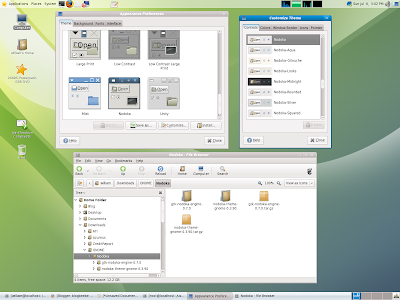
What is Nodoka? Nodoka is the default Gnome desktop theme originally delivered on Fedora 8. I've grown to like it so much that I installed it on other Linux distributions starting with Ubuntu 7.10 through 8.04. I've now installed it on Mandriva 2008 Spring PowerPack. Here's what I did. Install the Nodoka Engine Installation of the Nodoka engine requires building it from sources. To support the build of the Nodoka engine you'll need to install libgtk+2.0_0-devel. One way to install it is via Applications | Install & Remove Software | Software Management. You can find it by typing 'libgtk+' in Software Management's search bar, then select libgtk_2.0_0-devel from the top of the list (on my machine it was the fifth entry from the top). When you select it for installation you'll also automatically install additional packages to satisfy dependencies: - glib-gettextize-2.16.2-1mdv2008.1.i586 - libatk1.0-devel-1.22.0-1mdv2008.1.i586 - libcairo-devel-1.6.4-1....

Tis done

Image
Between cooking the family's Independence Day meal (barbecued chicken and ribs on the grill, Texas toast, fries baked in the oven, corn-on-the-cob and watermelon) and doing various jobs around the house I managed to fully install Mandriva Powerpack on europa. Installation was reasonably simple and straightforward. So far it's lived up to its promise and I couldn't be happier. Biggest surprise are the recent ATI drivers installed during the overall install. Another big surprise was when I went and grabbed Firefox 3 from mozilla.org and just installed it side-by-side with Firefox 2. Firefox 3 from Mozilla performs better than the final version delivered with Ubuntu 8.04. I'll finish up some time tomorrow. My weekends are just as busy as my workweeks, leaving little time to 'play'. I'm beginning to notice nice little touches in the Mandriva Gnome DE. Notice in the screenshot above that Nautilus' icon view shows a thumbnail of each movie. This feature has ne...

Eating Crow

Over a year ago adamw and I got into a circular pissing contest, when adamw wanted to know why it was that I spoke so glowingly of Ubuntu (version 7.04) after having barely installed it and just getting to know the distribution. I shot back with a tripe-laden response which brings nothing but embarrassment for me these days, especially in light of what I am about to do. But first, I'd like to publicly apologise to Adam. It's been over a year in coming, but Adam , if you're reading this, know that you were right and I was wrong . I've taken actions to back up those words. I've purchased a Mandriva Power Pack subscription and I've got the DVD burned and ready to install Mandriva 2008 Spring over Ubuntu 8.04.1. In addition to purchasing a Power Pack subscription I also purchased the USB key version. I'm waiting for it to arrive, hopefully sometime next week. I could spend the next hour of my personal time (and a lot of digital ink) listing in detail what has...

Am I missing something?

I'm looking at the latest batch of updates for Ubuntu 8.04, 17 in all. One set of updates is for the kernel. That's right, yet another kernel update. And why are we updating the kernel this time? So that we can shave 3 seconds off the boot-up sequence, from 36 seconds to 33 seconds. Here's the bug (240938) . The title of this entry comes from the last comment from Dave Miller: are we really all going to download updated kernels, with headers and all, just to shave 3 secs off the boot time? am i missing something? This kind of update, with the disruption to a working system, makes a mockery of one of open sources so-called strengths, which is how quickly flaws are found and fixed. What this update is attempting to correct is no flaw, fatal or otherwise. And it causes me (and others who do the same) to have to manually re-install ATI-supplied video drivers (and possibly nVidia as well, but I don't know). Under normal circumstances this isn't such a problem since kern...

Notes from the field: openSUSE 11 and ATI

openSUSE Downloaded, via BitTorrent (Azureus), openSUSE 11.0 Gnome LiveCD ISO. Burned the disk and booted europa with it. Took a look around, and in about five minutes came to the conclusion that I wasn't going to re-install SUSE back onto europa after all. Europa currently runs with Ubuntu 8.04, and 8.04 has had a slew of updates since its initial release and installation (update from 7.10, actually) on this box. It has the latest Firefox (3.0 official release), the latest OpenOffice (2.4.1), and a properly released version of gcc (4.2.3). When I booted the openSUSE LiveCD I found Firefox 3 Beta 5, OpenOffice 2.4.0, and just like with openSUSE 10.2, a pre-release of gcc, in this case 4.3.1. I found that with a simple 'cat /proc/version' to see what had been used to build the kernel. I can almost forgive everything except the gcc pre-release. In case the openSUSE devs missed it, gcc 4.3.1 was released May 19, 30 days ago. If they did build the kernel with the release gcc bu...

Mandriva 2008.1 KDE hits a sweet spot

Image
I've been installing some of the latest Linux releases for the past week to better understand what's available. I've taken the time to scrub the install system's (rhea) primary drive so that there's nothing on it any more except Linux. And I've tried to spend some time after the initial installation running some builds and installing other applications such as the latest Java and Netbeans, then running additional tests and comparing the results with past experiences. And the surprise, for me at least, is that the best distribution for me in this latest round isn't my old favorites openSUSE or Ubuntu, but Mandriva 2008.1 KDE. And for the record, I installed and tried to work with Fedora 9, and found that that particular dog just don't hunt. Working with Mandriva 2008.1 KDE reminds me of the past working with SuSE Pro and early versions of openSUSE, especially version 10.2. I have come to respect and even like Gnome, but KDE is my preferred desktop environ...

europa gets an upgrade

I let the dust settle a bit after Ubuntu 8.04's initial release last week before making any decision about upgrading europa. Europa was running Ubuntu 7.10, but Sunday I went on ahead and upgraded to Ubuntu 8.04. I did this not because I've changed my mind about Ubuntu, so much as I had a morbid curiosity about how it would work after an upgrade. And it was an upgrade, not a clean install. I surrendered to laziness and clicked on the upgrade manager's upgrade button. It took about two hours total to download over a gig of upgrades and to perform the installation of the new content. When it was finished and rebooted europa under 8.04 was almost indistinguishable from europa under 7.10. During the installation I kept my ATI drivers, and even installed the current latest, 8-4. I also discovered, after the installation, that 3D desktop effects were still borked, so I went looking yet again for the cause. I may have found the reason for failure not only for Ubuntu 8.04 but also...